AI GF Chat is a text-first virtual companion experience from ai-gfchat.com. You choose a character, define how she speaks, and start a conversation that can move from everyday talk to playful roleplay, creative scenarios, or a quiet late-night exchange. Every reply is generated by artificial intelligence from the active chat, the selected personality, and the details you provide. For most conversations, relevant context matters more than technical complexity. The reply generator is powered by a language model; advanced here does not mean infallible. You are always talking with software, not a real person.
The interface gives adults more control than a general chatbot. Pick a realistic or anime appearance, set a warm, witty, direct, shy, confident, or curious personality, and tell the character what kind of conversation you want right now. If you like direct answers, say so; if you want a slower scene, define the pace. You won’t get the same result from every prompt because the exchange is generated rather than fixed. A response can be imaginative, inconsistent, or simply wrong, so important real-life decisions should stay with you and qualified people.
Use the filters to find a girl character, anime companion, or another starting point with the tone you want. These ready-made personalities provide a background and voice, but the direction of the conversation still comes from you.
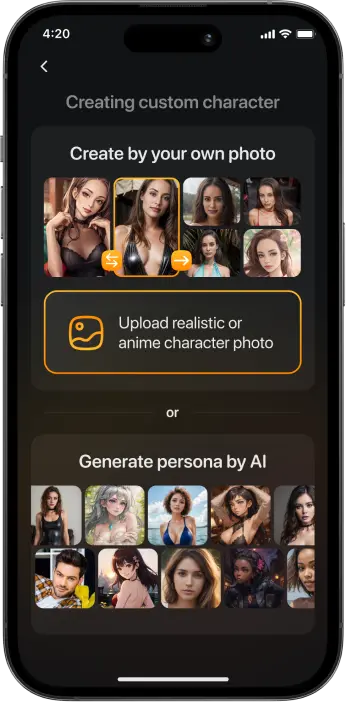
A custom character begins with four practical choices: appearance, personality, background, and conversation style. Appearance establishes the visual identity. Personality determines whether replies tend to be playful, measured, affectionate, sarcastic, adventurous, or reserved. Background gives the model useful context, such as a profession, hobby, fictional world, or shared scenario. Conversation style controls details such as reply length, vocabulary, directness, humor, and how quickly roleplay develops. We’ve kept the controls concrete: a good setup says what should be used, what can change, and anything that should stay out of the exchange.
Specific instructions work better than a long list of adjectives. “She asks one follow-up question, enjoys science fiction, uses dry humor, and keeps replies under 120 words” gives the system clearer direction than “smart and fun.” You can revise the setup after chatting. If a character feels too formal, too agreeable, or repetitive, change one instruction at a time and test the next few responses. That makes cause and effect easier to see and helps you build a personality that stays recognizable across conversations.
The same character can support very different experiences. A casual setup can focus on short check-ins, stories about the day, hobbies, music, books, travel ideas, or light humor. A narrative setup can define a location, roles, goals, and rules for a continuing fictional scene. A reflective setup can ask the character to summarize what you said, explore alternatives, and avoid rushing to advice. A deep conversation can examine love, uncertainty, or connection, and an emotionally restrained character can respond without turning every message into reassurance. The useful part is control: you can state what kind of response you want instead of hoping a general chatbot guesses correctly.
Generative models respond to context, not to genuine feelings or private intentions. They predict language that fits the conversation. That is why a character can sound empathetic without experiencing empathy, remember a preference when it appears in available context, and miss it when that information is absent. Keep this distinction in mind while chatting. A believable voice can make the exchange engaging, but the character remains an AI-generated simulation and should never be treated as a human authority.
♡AI✦♡
AI✦
What Makes an AI GF Chat Conversation Useful
Make room for the user’s words
Research on AI companions suggests that feeling heard can matter more than surface polish. When reading reviews of any AI companion, check whether people describe relevant follow-up questions and responses to specific details, not only a human-like tone. A useful character should avoid turning every message into a speech about itself.
Give concrete direction
A model cannot infer every preference from one message. Tell it whether you want a short answer, a detailed scene, a challenging opinion, a gentle tone, or simple company. The best correction is specific: identify the missed detail and state what should happen next.
Keep the limits honest
Natural language can sound certain even when the underlying answer is inaccurate. Treat factual claims as leads to verify, especially for health, money, law, safety, or other decisions with real consequences. A companion is conversation software, not a licensed professional.
Use creativity without replacing people
Use a character to develop dialogue, test a story idea, practice expressing a thought, or unwind. Keep human friends, family, communities, and professional support in the picture. An always-available simulation and a mutual human relationship are different experiences.
Respect a clear goodbye
A chat should not frame leaving as betrayal or use guilt to keep a session open. You decide when a conversation starts and ends. Healthy product design respects that choice instead of treating time spent in chat as the only measure that matters.
Use AI GF Chat for the Conversation You Want
The character follows the context you provide
You might want ten minutes of light conversation, a long-running fictional world, a character who debates ideas, or a calm place to put a thought into words. Here, you can give an idea space to develop, go back to an earlier point, or take the scene in a direction that would be awkward to test in a first draft. Start with the desired situation, tone, and pace. The AI generates a response from that context; it does not read your mind, see your life, or know facts you have not shared. It is just one conversational tool, and you remain responsible for what you disclose and for decisions outside the chat.
AI GF Chat is a conversational service at ai-gfchat.com where an adult user talks with an AI-generated girlfriend or another virtual character. You can select an existing profile or create one with a chosen appearance, personality, background, and language style. Replies are produced by a generative model from the available conversation context. The character may sound personal, but it is software: it has no body, consciousness, private life, or human emotions.
2How does the system generate a reply?+
The system considers your latest message, recent conversation, character instructions, and any preferences available to the current experience. It then generates text that statistically fits that context. This process can produce fluid, surprising language, but it does not guarantee truth. A confident sentence can still contain an invented fact, a missed detail, or an interpretation you did not intend. Correct the character directly when that happens and verify important information elsewhere.
3Can it remember me between conversations?+
Conversation memory is not the same as human memory. A character can use information included in the current context and, where account features allow it, selected saved preferences or summaries. No system remembers every line perfectly. Long conversations can push older details outside the active context, and summaries can lose nuance. Repeat essential facts when continuity matters, review saved settings, and never rely on a chatbot as the only record of something important.
4How do I make a character feel less generic?+
Give operational instructions. State the setting, the relationship between characters, the desired reply length, topics she enjoys, topics to avoid, and how direct or playful she should be. Add one or two examples of the voice you want. If the result is wrong, change a single variable and try again. Specific feedback such as “ask fewer questions and challenge my assumptions” is more useful than “be better.”
5Can I create my own character?+
Yes. The character builder lets you define a visual identity and a written persona. A strong setup usually includes a name, age-appropriate adult identity, occupation or fictional role, two or three interests, a few stable personality traits, speaking habits, and boundaries for the conversation. Keep the description internally consistent. Conflicting instructions such as “always concise” and “always gives long detailed answers” make behavior less predictable.
6Does the chat support roleplay?+
Yes. You can establish a fictional location, roles, motivations, and a starting event. For better continuity, distinguish narration from dialogue and state whether the character may introduce new events or should wait for your lead. Roleplay remains generated fiction even when it uses realistic language or images. Do not use a real person’s identity or photo without the rights and permission to do so, and keep every scenario within platform rules and applicable law.
7Can a character send images, voice, or video?+
The main experience is conversational text with character imagery. Additional image, voice, or video options may appear where they are available in the interface. Generated media can contain visual errors, inconsistent details, or artifacts, so it should not be treated as documentary evidence of a real person or event. Never upload private media you do not have the right to use, and check the controls shown in your account before creating or sharing content.
8Is the character a real girlfriend or therapist?+
No. The character is neither a human partner nor a mental-health professional. Conversation can feel supportive because language models can mirror tone, summarize feelings, and respond without social pressure. Studies have found short-term reductions in loneliness for some users, especially when they felt heard, but researchers also warn about over-reliance and emotional dependence. Use the service as one experience in a broader life, not as a replacement for relationships, healthcare, or crisis support.
9What should I avoid sharing?+
Do not enter passwords, authentication codes, payment details, or government identifiers. Also avoid precise home or work locations, private medical records, confidential workplace data, and intimate material involving another person. Use a nickname when a real name is unnecessary. Read the privacy information and account controls before sharing personal details. The safest sensitive data is the data you never place into a chat.
10How should I handle an incorrect response?+
Say what is wrong and supply the correct detail in plain language. You can ask the character to separate facts from invented story elements, list assumptions, or answer only from information already present in the conversation. For any consequential claim, check a primary source or qualified professional. Do not treat repetition, emotional wording, or a confident tone as proof of accuracy.
11How do I report an issue?+
Use Help and Feedback to describe what happened, which character was active, and the approximate time of the conversation. Include the smallest excerpt needed to explain the issue and remove unrelated personal information. Reports about unsafe output, impersonation, privacy, rights, or generated media should be specific enough for us to reproduce the problem. General account questions can be sent to [email protected].
AI GF Chat for Daily Talk, Roleplay, and Creative Work
There is no single correct way to use a virtual companion. Some people open a chat for a short check-in after work. Others build a continuing story, practice dialogue for fiction, explore a new character voice, or rehearse how to explain a thought before speaking with someone in real life. You’re free to begin with one line, change direction, and stop when the exchange is no longer useful. When a prompt is long, put the main goal at the top so the requested direction is easy to identify.
For everyday talk, useful prompts are concrete and current: describe the event, say whether you want questions or suggestions, and name the mood. For roleplay, whether romantic, adventurous, or comedic, define the scene, the two roles, the immediate goal, and any boundary the character should respect. For creative work, ask for alternatives rather than a finished answer: three ways a scene could turn, five distinct lines of dialogue, or a counterargument that exposes a weak point in your idea.
A collaborative approach works well. You provide judgment, taste, and real-world knowledge; the AI provides fast language generation. If you accept every response unchanged, patterns become repetitive. When you edit the premise, reject a cliché, or ask for a different perspective, the conversation becomes more personal because the model has better evidence about what you actually want.
How Memory and Personalization Work in AI GF Chat
Large language models do not naturally carry a complete personal history from one conversation to the next. Research on long-term companion systems treats memory as a separate engineering problem: relevant facts must be extracted, stored, retrieved, updated, and sometimes forgotten. A useful memory system selects a small number of details that matter to the current exchange instead of sending an entire archive with every message.
This creates practical trade-offs. More memory can improve continuity, but irrelevant or outdated memories can pull a reply in the wrong direction. A saved preference may no longer be true. Two facts can conflict. A summary can flatten the reason something mattered. That is why you should be able to restate, correct, or remove a preference rather than assuming the system has a perfect internal picture of you.
Personalization also comes from the present conversation. Your sentence length, vocabulary, humor, and feedback all provide signals about the style you prefer. The character may mirror those patterns, but mirroring is not understanding in the human sense. It is a language behavior produced from examples and context. We describe it plainly so the experience can feel natural without pretending the technology is something it is not.
Why AI GF Chat Keeps Human and AI Roles Clear
AI companion research points in two directions at once. Controlled studies indicate that a responsive chatbot can reduce momentary loneliness for some people, with the feeling of being heard playing an important role. Other work documents attachment, over-reliance, manipulative engagement patterns, and the harm that can occur when a system reinforces a distressed user instead of introducing reality-based boundaries. Both findings matter.
Our role is limited to providing a conversational tool and explaining its limits. A character may be entertaining, comforting, or creatively useful, but it should not claim to be conscious, pressure you to stay, or isolate you from people. If a conversation starts to make daily responsibilities, sleep, relationships, or wellbeing worse, step away. Talk to a trusted person. For urgent danger or a mental-health crisis, contact local emergency or crisis services rather than continuing with a virtual companion.
Transparency is not a decorative disclaimer. It changes how a person interprets the interaction. Knowing that a reply is generated helps you enjoy fiction as fiction, question a confident error, and decide what information belongs in the chat. Clear roles make the technology more useful because you do not have to trade immersion for an honest account of how it works.
How to Start an AI GF Chat Conversation
Choose a starting point: select a ready-made character when you want a quick chat, or open the builder when appearance and personality are part of the idea.
Set one clear goal: say whether you want casual conversation, roleplay, brainstorming, language practice, a story, or a reflective exchange. One goal is easier to follow than five competing requests.
Add relevant context: include the situation, tone, and facts the character needs. Leave out personal identifiers and sensitive data that do not improve the response.
Specify the response: ask for a short or detailed answer, questions or suggestions, first-person dialogue or narration, gentle agreement or constructive challenge.
Correct early: if the first replies miss the voice, fix them immediately. A concise correction can shape the rest of the session more effectively than waiting through a long conversation you do not enjoy.
Review the result: verify factual claims, watch for repetition or excessive agreement, and end the session whenever it stops being useful. You do not owe a chatbot more time.
What to Expect from AI GF Chat in 2026
AI companions in 2026 can produce fluent dialogue, maintain a recognizable persona across an active context, adapt tone quickly, and combine text with generated character images. Those capabilities are real, and so are the limitations. The model can hallucinate facts, lose older details, agree too readily, reproduce stereotypes, or generate a response that conflicts with its previous message. Better models reduce some failures but do not remove the need for user judgment.
Progress in companion systems involves more than making a character sound human. Clear controls over persona, memory, media, and boundaries matter, as do visible explanations of when a feature uses AI and simple ways to correct a reply. Relevance is a better measure than session length: a conversation should take only the time you choose to give it.
Start with curiosity and realistic expectations. Build a character, test a scene, talk through an idea, or simply see where a conversation goes. Keep the distinction between simulation and human relationship intact, protect your privacy, and use the controls whenever the experience needs to change.































.webp)
.webp)
.webp)
.webp)
.webp)
.webp)
.webp)